Thomas Vozar
Assistant Professor of Humanities
CSE 0456
M 1:00 PM -3:00 PM and by appointment
Thomas Matthew Vozar is a scholar of early modern literature and intellectual history with particular expertise in the writings and thought of John Milton. His core research interests lie in learned culture, classical reception, the history of scholarship, Neo-Latin studies, the European republic of letters, and conceptions of intellectual, academic, and political liberty, but his work also extends into such (often intersecting) areas as book history; Shakespeare and Renaissance drama; orientalism and European-Islamic encounters; and colonial America. He has published numerous articles on these and other subjects in peer-reviewed journals and edited collections, which have garnered such accolades as the Natalie Zemon Davis Prize for the best article in Renaissance and Reformation / Renaissance et Réforme and the Calvin and Rose G. Hoffman Prize for the best essay on Shakespeare and Christopher Marlowe.
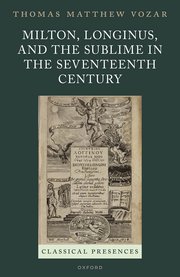
His books include Milton, Longinus, and the Sublime in the Seventeenth Century (Oxford University Press, 2023), which won the Milton Society of America’s James Holly Hanford Book Award, and the newly released Isaac Barrow’s On the Turkish Religion: A Latin Poem on Islam from Ottoman Istanbul (Bloomsbury, 2026), which offers the first ever annotated edition and translation of De Religione Turcica, a Latin poem on Islam composed during a visit to Istanbul in the late 1650s by the Cambridge scholar (and mentor of Isaac Newton) Isaac Barrow
Current Project
Vozar is completing final revisions on a second monograph, Polemical Erudition: Scholarship and Politics in the European Republic of Letters during the English Revolution. Investigating the intersections of British politics with European learned culture in the 1640s and 1650s and treating such figures as John Selden, Georg Horn, Claudius Salmasius, and John Milton, Polemical Erudition demonstrates the extent to which the English Revolution was not only waged on the battlefields of Naseby and Worcester but was also fought across Europe, often in Latin, in erudite polemics, treatises, disputations, lectures, commentaries, epigrams, and letters.
He is also currently embarking on a new project, provisionally entitled Liberty to Know: Free Speech and the Advancement of Knowledge from Areopagitica to the First Amendment, which has been supported by a Haworth Free Speech Fellowship from the Russell Kirk Center and a Maddock Research Fellowship for archival work at Marsh’s Library, Dublin.
Courses
Education
-
Ph.D. in English, University of Exeter, 2021
-
M.A. in Classical Studies, University of Pennsylvania, 2015
-
B.A. in Latin (High Honors), Oberlin College, 2013
Publications - Books
Isaac Barrow’s On the Turkish Religion: A Latin Poem on Islam from Ottoman Istanbul
Publications - Articles
“Thomas Young as Puritan Exile among the Merchant Adventurers in Hamburg and Milton’s Elegia Quarta,” forthcoming in Milton Studies.
“Thomas Farnaby’s 1613 Edition of Seneca’s Tragedies and Shakespeare’s Julius Caesar,” forthcoming in Notes & Queries.
“Epigrams on the Castrated Martial: From Joseph Scaliger to John Donne and Beyond,” forthcoming in Renaissance Quarterly.
“‘Miltoni petulans epigramma’: Did Milton Write the Pontia Epigram?” Milton Quarterly 59.2 (2025), 76–81.
“The Leipzig Edition of Milton’s Pro Populo Anglicano Defensio,” Papers of the Bibliographical Society of America 119.2 (2025), 239–254.
“Oriental Scholarship and Episcopal Polity: The Reception of John Selden’s Arabic-Latin Edition of Eutychius,” Journal of Ecclesiastical History 76.2 (2025), 319–334.
“Elizabeth Jane Weston’s Verses on the Death of Holy Roman Emperor Rudolf II,” Notes & Queries 72.1 (2025), 48–49.
“Academic Freedom in the English Revolution: Libertas Scholastica, Libertas Philosophandi, and the Reformation of the Universities,” Journal of the History of Ideas 86.1 (2025), 49–73.
“Constantijn Huygens, Antonius Thysius, and the Leiden University Sammelband of the Works of Margaret Cavendish,” Quaerendo 54.4 (2024), 317–330.
“The Sidney Brothers, Elizabethan Travelers, and Hugo Blotius, Prefect of the Imperial Library in Vienna,” Sidney Journal 42.1 (2024), 59–72.
“On the Indexes in Some Continental Editions of Milton’s Pro Populo Anglicano Defensio and Salmasius’s Defensio Regia, with an Addendum on the Publisher Adrienne Brillet,” The Library 25.2 (2024), 147–164.
“African Latin in Early Modern Thought: Language, Race, and Philology,” Renaissance and Reformation / Renaissance et Réforme 47.1 (2024), 39–59. Winner of the Natalie Zemon Davis Prize.
“The English Renaissance Playwright’s Classical Encyclopedia: The Antiquae Lectiones of Caelius Rhodiginus as a Resource for Jonson and Chapman,” Ben Jonson Journal 31.1 (2024), 104–112.
“London’s First Public Library: Books and Readers at Sion College, c. 1630–1660,” Milton Studies, 66.1 (2024): 77–97.
“Robert Hooke, Isaac Newton, and the Royal Society: Three Unnoticed Letters at the Staatsbibliothek zu Berlin,” Notes and Records: The Royal Society Journal of the History of Science, 78.1 (2024).
“An Unpublished Autograph Letter from Sir Philip Sidney to Carolus Clusius, 21 April 1576,” Renaissance Studies, 37.4 (2023): 477–546.
“2 Henry VI and the Tomb of Duke Humphrey,” Shakespeare, 19.4 (2023): 586–591.
“Julius Caesar and the Revenge Plot from Oxford to Shakespeare’s Globe,” Review of English Studies 74.315 (2023): 456–469.
“A Cambridge University Greek Textbook at Harvard College in 1642,” New England Quarterly 96.1 (2023): 64–73.
“The New Science and the Virtuoso Reader in Thomas Creech’s Lucretius,” Modern Philology 120.3 (2023): 356–377.
“Isaac Barrow, Ali Ufki, and the Epitome Fidei et Religionis Turcicae: A Seventeenth-Century Summary of Islam in the European Republic of Letters,” Journal of the Warburg and Courtauld Institutes 85 (2022): 145–163.
“Mallecho or Malligo? A Crux in Hamlet Revisited,” Notes & Queries 69.4 (2022): 291–293.
“Alcaics on Restoration Actresses by the Cambridge Classical Scholar James Duport,” Early Theatre 25.2 (2022): 83–88.
“Neo-Latin Epigrams on John Milton by Peder Winstrup, Bishop of Lund, and the Rothenburg Jurist Georg Christoph Walther,”Humanistica Lovaniensia 71.1 (2022): 115–124.
“Selden’s Reply to Salmasius, an Alternative Title for the Pro Populo Anglicano Defensio, and Why Milton Deserves to Be Strangled: Rumour and Opinion in the Correspondence of Guy Patin,” The Seventeenth Century 37.6 (2022): 937– 947.
“Supernaculum: Nashe’s Dog Latin for a Germanic Drinking Custom,” Notes & Queries 69.1 (2022): 17–19.
“Henry Oldenburg and a Brief Notice of Milton’s Of Education in the Philosophical Transactions,” Milton Quarterly 55.1 (2021): 63–66.
“Timor Dei and Timor Idololatricus from Reformed Theology to Milton,” Reformation 26.1 (2021): 62–72.
“An English Translation of Longinus in the Lansdowne Collection at the British Library,” The Seventeenth Century 35.5 (2020): 625–650.
“Sir Henry Wotton’s Copy of Portus’ Aphthonius, Hermogenes, & Dionysius Longinus,” Notes & Queries 66.3 (2019): 473–474.
“On the Fifth Stanza of the Carmen Saeculare,” Latomus: Revue d’études latines 78.1 (2019): 186–191.
“Schneider’s Conjecture on Bellum Alexandrinum 13.5,” Rheinisches Museum für Philologie 161.2 (2018): 238–239.
“Body-Mind Aporia in the Seizure of Othello,” Philosophy and Literature 36.1 (2018): 183–186.